

- Why AI search tools like Perplexity feel fundamentally different from Google — and why that difference matters.
- Where Perplexity genuinely outperforms Google, and where Google still wins.
- A clear feature-by-feature comparison: accuracy, speed, citations, privacy, and pricing.
- The honest answer to whether AI search is finally better than traditional search in 2025.

For over two decades, searching the internet meant one thing: opening Google, typing a query, and wading through a page of blue links. That model has worked — remarkably well — but it is starting to show its age. The modern Google results page is increasingly crowded with ads, SEO-optimized content farms, and sponsored results competing for the same real estate as genuinely useful answers. Users are noticing, and some are leaving.
Perplexity AI arrived in late 2022 with a different proposition entirely. Instead of returning a list of links and asking you to do the synthesis, it reads those sources itself, constructs a direct answer, and shows you exactly where every claim came from. It is less a search engine in the traditional sense and more an answer engine — a conversational research assistant that happens to have the entire indexed web at its disposal.
The question that now hangs over every technology discussion is deceptively simple: is AI search actually better? Not better in a marketing sense, but better in the way that matters — more accurate, more useful, faster, and more trustworthy for the kinds of queries real people perform every day. This guide gives you a rigorous, honest answer.
The Core Philosophical Difference
Before comparing specific features, it is worth understanding the fundamental architectural difference between the two tools, because it shapes everything else.
The fundamental difference between Perplexity and Google comes down to a simple question: do you want a direct answer, or do you want a list of places to find an answer? Perplexity is a conversational AI answer engine at its core, designed to synthesize information and give you a straight response with its sources cited. Google, on the other hand, is a massive link ecosystem that has started layering AI on top of its traditional results.
Perplexity AI is often called the "AI search engine," but it works differently from Google. Instead of giving you a long page of blue links, Perplexity pulls answers directly from trusted sources and presents them in a conversational way. The result is a strikingly different user experience — one that eliminates the clicking, skimming, and synthesizing that traditional search implicitly demands of the user.
The user's journey is shifting from hunting and clicking to simply asking and receiving. For anyone in SEO or content, the game has changed. We're moving from a world of optimizing for clicks to a new reality of optimizing for citations. Your content now has to be so good that an AI will use it as a trusted source.
Growth and Market Position
The numbers behind Perplexity's rise are striking enough to demand attention from anyone who assumed Google's dominance was permanent.
Perplexity AI has seen incredible growth, jumping from 230 million monthly queries in August 2024 to an impressive 780 million by May 2025 — a 239% spike in less than a year. That trajectory suggests genuine product-market fit, not just curiosity-driven experimentation.
At the same time, context matters. Google's reach remains unmatched. According to StatCounter, Google controls 89.7% of the global search engine market as of mid-2025. Perplexity is growing fast, but it is growing from a very small base against the most dominant consumer product in the history of the internet.
Experts from Gartner and McKinsey see Perplexity challenging Google in AI-driven search, predicting a 25% decline in traditional search volume by 2026 as agentic tools gain traction, highlighting Perplexity's edge in synthesized insights. Whether those predictions prove accurate, the directional signal is clear: the search landscape is genuinely changing.
Where Perplexity Wins: Research and Depth
The most significant performance gap between the two tools appears in research-intensive queries — the kind where you need a synthesized answer from multiple sources, not a starting point for further reading.
For questions like "How do I steam dumplings without a steamer?" or "Summarize the key points of the latest AI safety paper," Perplexity consistently outperformed. It generated concise, structured answers with citations and often included relevant video links. The entire process took seconds, and there was no need to click through SEO-optimized blogs or skim through forum chatter. This makes it especially valuable for time-sensitive research, technical writing, or academic exploration.
For academic or professional work, Perplexity shines. In one test, it was used to pull data on renewable energy adoption in Southeast Asia — the tool returned 12 cited stats, a comparison table of 5 countries, and links to each country's energy ministry in 30 seconds.
Perplexity shines in research by providing summarized answers with verifiable sources, reducing the time spent clicking links compared to Google's list-based results. For professionals who regularly need to synthesize information quickly, that time saving compounds into something genuinely meaningful over weeks and months of daily use.
Here's what the actual outputs look like when you run the same developer-focused query through both tools:
Side-by-side comparison from a developer workflow test. Both tools handle the query, but the depth and citation structure differ noticeably. Source: index.dev
Where Google Still Wins: Local, Commercial, and Casual Queries
Perplexity's strength in research depth comes with a corresponding weakness in the everyday queries that make up the majority of most people's search activity.
For casual questions, like "local weather forecast for next Tuesday" or "movie showtimes near me," Google wins. Its overviews tie into maps and calendars seamlessly — tap the forecast, and you can add a rain alert to your phone. No extra steps needed.
Google's AI Mode places an AI-generated summary at the top of search results, pulling from Google's massive index. It's fast — often the fastest first-token response of any AI search tool — and it leverages Google's unmatched infrastructure for local, maps, shopping, flights, and real-time information.
Google still wins on exploratory, meandering searches, and Perplexity struggles to retrieve some basic resources. Perplexity wins on LLM-friendly queries like how-to guides and crisp summarization, and is at parity when it comes to recalling most individual facts. That pattern — each tool with a distinct domain of superiority — is the most honest summary of the current competitive landscape.
Accuracy: The Most Important Variable
Any discussion of search quality has to engage seriously with accuracy. A faster, cleaner answer that is wrong is worse than a slower, messier one that is right. Both tools have real limitations here, and neither should be trusted uncritically.
In 2025, Perplexity's workflow relies on retrieval-augmented generation (RAG), meaning answers are grounded in public web pages rather than purely model-generated text. Perplexity crawls the web, selects top-ranked sources, and constructs an aggregated response. The system emphasizes citation visibility, allowing users to check each referenced source.
Scoring 93.9% accuracy on the SimpleQA benchmark — a bank of several thousand questions that test for factuality — Perplexity Deep Research far exceeds the performance of leading models. That benchmark result is impressive, but benchmarks measure specific, controlled conditions that don't always generalize to the messy reality of everyday queries.
Despite its strengths, Perplexity remains limited by the quality of public web data. It does not perform as well in areas requiring deep reasoning, multi-step logic, or substantial domain expertise. Perplexity may state incorrect claims with confidence when its sources are weak. This is the critical failure mode to watch for: the tool's confident, well-formatted presentation can make errors harder to detect than they would be in a raw list of links where you still bear responsibility for evaluation.
Speed: A Clear Win for Perplexity
On raw response speed for complex queries, the gap between the two tools is measurable and consistent.
Perplexity's response time clocks in consistently lower for complex queries. In one test — asking for breakdowns of 2025 climate policy updates across three continents — it delivered in under two seconds. Google's overview took nearly double that, especially when pulling in data from multiple sources. The gap never closed by more than 0.3 seconds across five repeated tests.
For simple questions, the platform maintains an average response time of just 1.2 seconds, ensuring users receive answers almost instantly. For more complex or multi-part queries, Perplexity still delivers quickly, with an average response time of 2.5 seconds, maintaining a smooth user experience.
A follow-up test on a developer-specific query about API authentication changes produced these outputs:
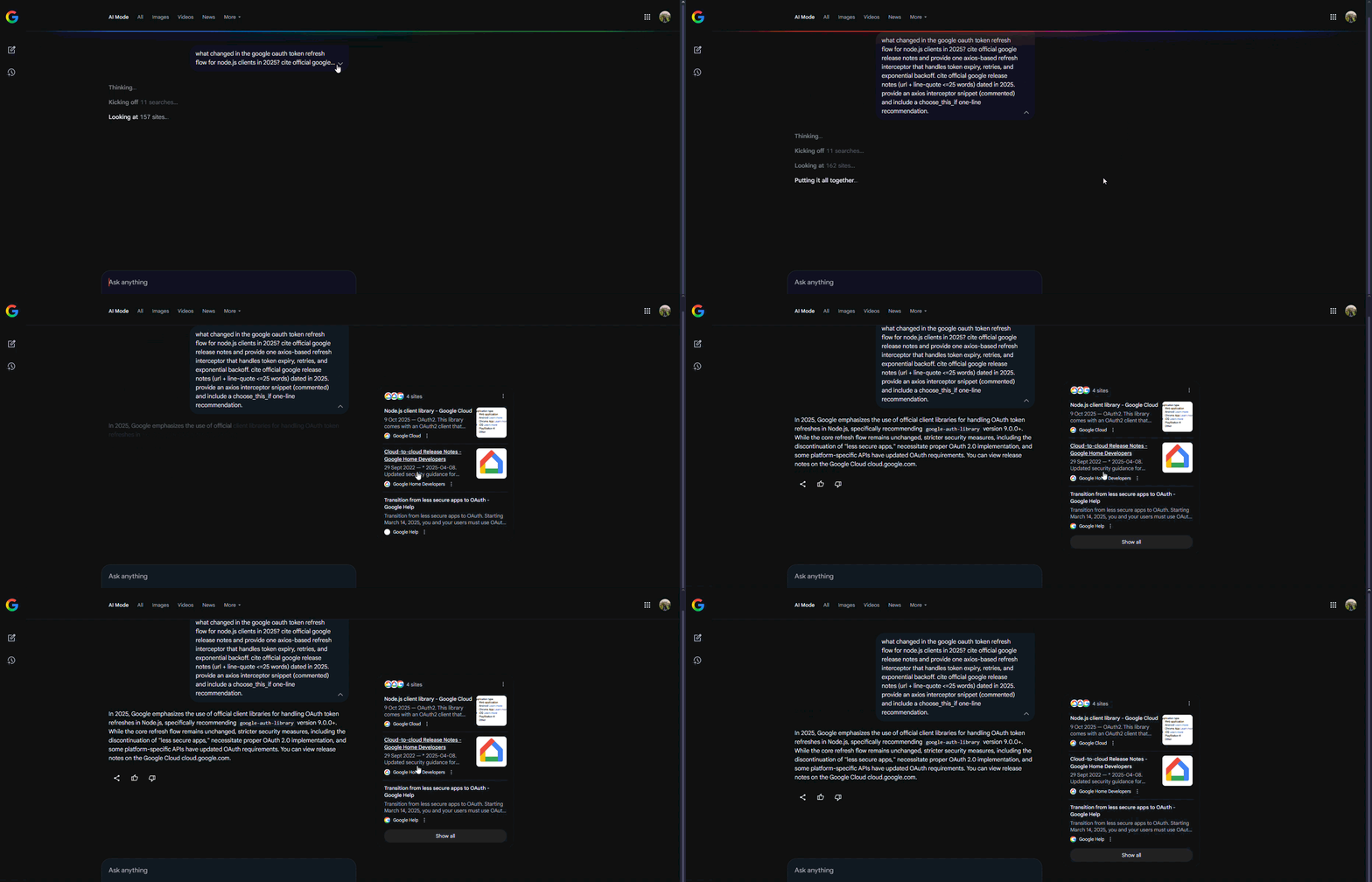
Technical query test: tracking 2025 API authentication changes. Perplexity returned actionable code; Google provided a high-level library recommendation. Source: index.dev
Privacy: A Genuine Differentiator
For users who care about data privacy, the comparison between the two tools is meaningfully different — though neither is without concerns.
From a privacy perspective, Perplexity stores all your searches in threads — unless you explicitly turn on private mode. Google's data retention and ad targeting mechanisms are well-known. For those concerned about surveillance capitalism, Perplexity may feel like a step in the right direction, though it is not immune from tracking.
Google's AI summaries compete for screen space with ads, "People Also Ask" boxes, knowledge panels, and sponsored results. The information density per pixel is lower than Perplexity's clean interface. For users tired of navigating an increasingly commercial search experience, that cleaner presentation is itself a meaningful quality-of-life improvement.
Pricing: Free vs. Free, Then $20/Month
Both tools offer free access, but the ceiling of the free tier differs significantly, and the value of upgrading is much clearer for Perplexity than for Google.
Perplexity's free plan gives 5 deep searches daily (think: multi-source synthesis), with unlimited basic queries. Its Pro tier, at $20/month, unlocks 300 deep searches and premium models. Google's overviews are free, but supported by ads — meaning more data collection to target those ads, a tradeoff many users accept for no cost.
Perplexity Pro offers a significant upgrade over the free version by unlocking 10× richer citations, unlimited file uploads, access to premium AI models, and deeper research tools such as Pro Search, Research Mode, and Labs. These features allow users to analyze documents, run multi-step investigations, and generate images or limited videos with higher precision and context. For anyone doing complex research, writing, content creation, or data-heavy work, Pro delivers faster, more transparent, and more capable results than the free tier.
Google's Response: AI Overviews and the Road Ahead
Google is not standing still while Perplexity grows. The company's response has been substantial, and it deserves honest assessment rather than dismissal.
Google isn't sitting still. Its Gemini-powered AI Overviews are already rolling out to over a billion users, and the company is testing a full AI-first search mode in Search Labs. These updates promise more conversational answers, fewer clicks, and better summarization — without killing its golden goose: ads.
The difference is in execution: Perplexity AI cites multiple sources right away, while Google SGE sometimes paraphrases without clear links. Perplexity feels like a research assistant, while SGE feels like a quick preview before clicking into sites. SGE is Google's way of catching up, but Perplexity was built for this style from the start.
The structural challenge for Google is that it cannot fully embrace the AI answer model without undermining its own advertising business. Google's overviews can drop click-through rates by 18–64% for top-ranked pages, according to Ahrefs 2025 data. Every query that gets fully answered by an AI summary is a query that doesn't generate ad revenue from a click. That tension shapes every product decision Google makes in this space, and it is not a tension Perplexity faces.
The Full Feature Comparison
| Feature | Perplexity AI | Google Search | Winner |
|---|---|---|---|
| Answer Format | Direct synthesized answer with inline citations | List of links + AI Overview summary | Perplexity (for depth) |
| Citation Quality | Inline, sentence-level citations for every claim | Source links below summary, less granular | Perplexity |
| Local & Commercial Search | Limited — no maps, no showtimes, no real-time local data | Excellent — integrated with Maps, Shopping, Flights | |
| Research Depth | Deep Research mode: multi-source synthesis in 2–4 min | AI Overviews: quick summaries, less depth | Perplexity |
| Speed (complex queries) | ~1.8–2.5 seconds for multi-source synthesis | ~4–5 seconds for comparable AI Overview | Perplexity |
| Privacy | No ads; private mode available; less data tracking | Ad-supported; extensive data collection | Perplexity |
| Pricing | Free (5 deep searches/day); Pro at $20/month | Free (ad-supported) | Tie |
| Ecosystem Integration | Standalone; browser extension available | Deep — Gmail, Drive, Maps, YouTube, Android | |
| Real-Time Data | Strong — no knowledge cutoff, live web crawling | Excellent — near-instant news, scores, prices | Tie |
| Follow-Up Questions | Native — full conversational thread with memory | Limited — some follow-up, less conversational | Perplexity |
Who Should Use Which Tool
The most honest conclusion from a thorough comparison is not that one tool has defeated the other — it is that they currently serve different use cases, and intelligent users will learn to move between them based on what a given query actually requires.
This comparison boils down to purpose: Perplexity for research depth, Google for quick breadth. That framing is simple but accurate. The mistake is treating it as a binary choice when the reality is that both tools are free, both are fast, and the cognitive cost of switching between them is essentially zero.
Tech professionals and students are increasingly using Perplexity to bypass what's often called the "SEO swamp" that traditional search has become — a results page where the highest-ranking content is optimized for algorithmic visibility rather than genuine usefulness. For any query where you need synthesis rather than discovery, that migration makes complete sense.
For everything else — local searches, quick fact checks, commercial queries, news, sports scores, navigational searches where you already know the destination — Google's infrastructure and ecosystem depth remain genuinely superior, and no amount of AI polish from a startup changes that calculus in the near term.
Is AI Search Finally Better?
The honest answer is: better at some things, not yet at others, and improving fast enough that the balance will continue to shift.
Perplexity AI scratches an itch many users feel: fast, readable answers backed by sources you can check. It shines when you want quick syntheses and verifiable starting points for research. For that specific use case — which constitutes a meaningful portion of all search queries — the AI approach is not just marginally better. It is fundamentally better in ways that become obvious within minutes of regular use.
But "AI search is better" as a blanket statement is still too strong. The tool that is better depends entirely on what you need from a given search, and Google's two-decade head start in local data, ecosystem integration, and commercial infrastructure cannot be closed by a better answer format alone. What has changed is that Google's monopoly on the concept of "searching the internet" has ended. There is now a genuinely viable alternative for a significant and growing class of queries, and that alternative is improving faster than its incumbent competitor.
🏁 The Verdict
Perplexity AI is genuinely better than Google for research-heavy, synthesis-requiring queries — and that advantage is real, measurable, and growing. If your search involves understanding something rather than finding something, Perplexity is the better tool in 2025, and it isn't close.
Google remains superior for local searches, commercial intent, ecosystem-integrated tasks, and the casual exploratory browsing that makes up much of everyday internet use. Its infrastructure advantages in these areas are structural, not cosmetic, and won't be erased by a better AI model.
The smartest approach is to use both deliberately. Let the nature of your query determine which tool you open — and resist the habit of defaulting to Google simply because it has been the default for twenty years. The habit is understandable. In 2025, it is no longer optimal.
Try Both Tools and See For Yourself
The fastest way to form your own opinion is to take five queries you ran on Google last week and run them on Perplexity. The difference will be immediately apparent — and you'll quickly develop an instinct for which tool belongs in which situation.
