
 |
| Source: Apple |
This was the big anticipation of Apple's evening conference: the presentation of the M3, M3 Pro and M3 Max chips . This new generation of Apple Silicon SoC will logically find its place in all new Macs and MacBooks for the coming year. It marks a real gap with the M1 generation thanks to a change in the manufacturing process.
Transition to 3nm
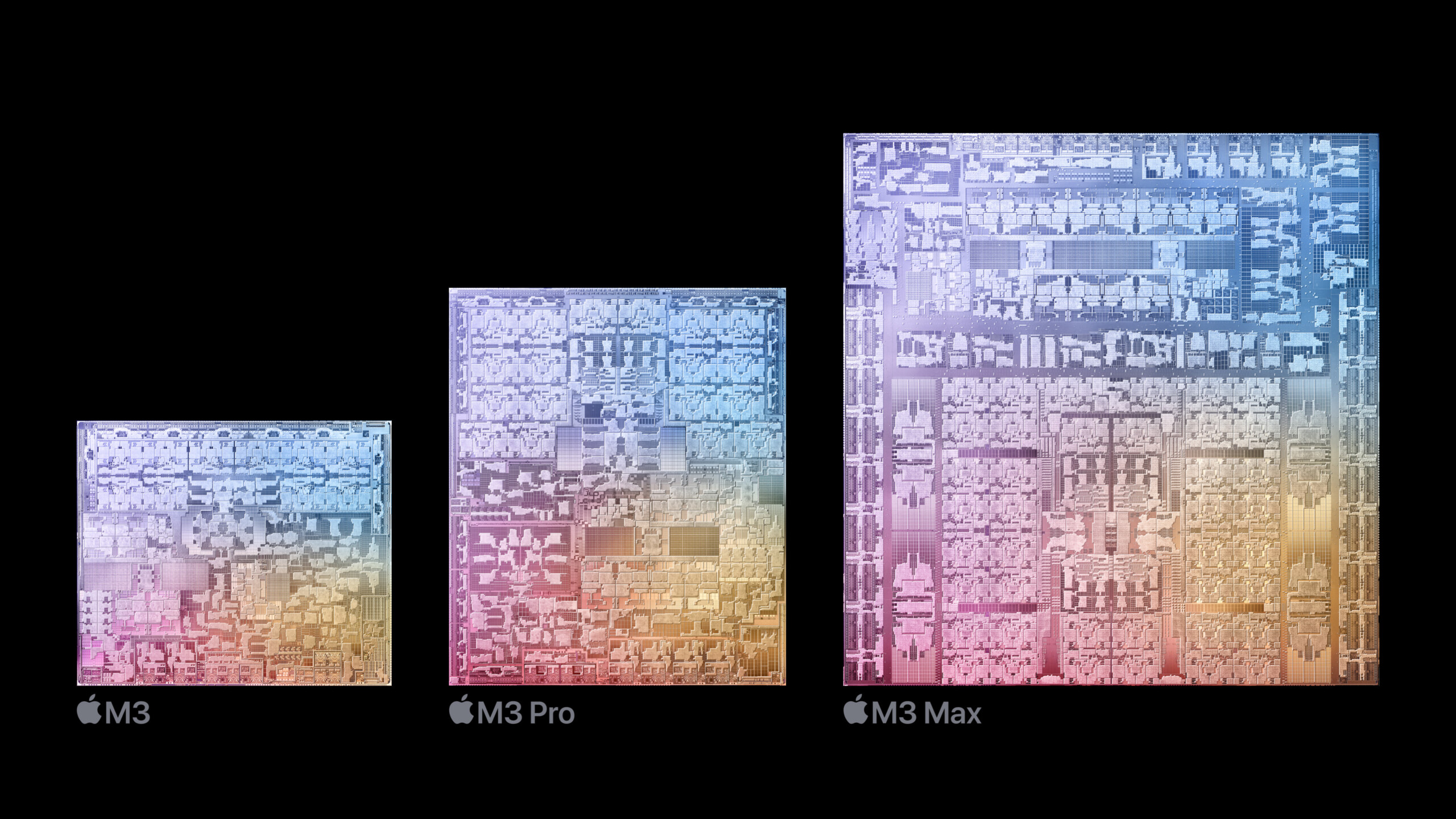
The first big novelty is the use of the TSMC N3 manufacturing process. This is the first real change in the manufacturing process for a Mac chip at Apple since the M1 and M2 generations were respectively based on TSMC's N5 and N5P processes.
This means that Apple can, for the same chip size, allocate more space to new functions or to more CPU or GPU cores and thus increase the performance of its chip.
 |
| Source: Apple |
Being able to launch mass manufacturing of three chips at once, M3, M3 Pro and M3 Max using such a new manufacturing process was a real industrial challenge that Apple seems ready to take on.
A more efficient processor
 |
| Source: Apple |
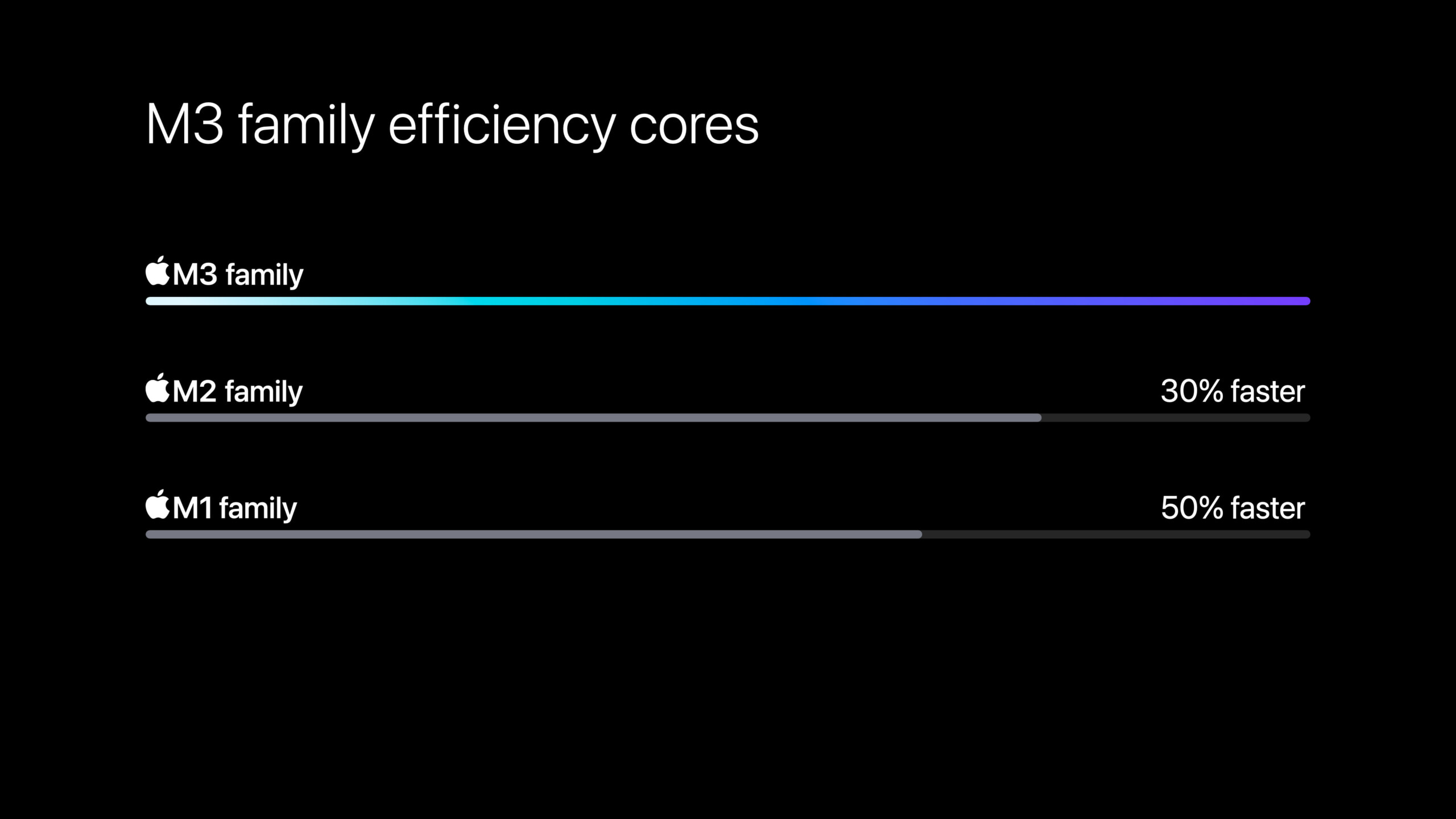
According to the firm, the low-power cores are now up to 50% faster than the Apple M1 chip, or 30% than the Apple M2 chip.
On high-performance cores, the Apple M3 chip would offer up to 30% more computing power compared to the Apple M1, or 15% compared to the Apple M2.
A new graphics chip: ray tracing
Apple has focused most of its efforts on the architecture of its graphics chip. It is with it that the firm wants to convince developers and players to make the Mac a real gaming machine.
Among the major new features, there is the hardware acceleration of ray tracing which was eagerly awaited after its arrival in the A17 Pro of the iPhone 15 Pro.
Apple is also adding support for mesh shading , a technology that is less talked about than ray tracing , but which is just as important for supporting modern games.
If the MacBooks ran Windows, we could say that Apple's graphics chip meets the specifications of DirectX 12 Ultimate. Mesh shading allows you to manage more complex geometry in a game and therefore gain fidelity in terms of 3D modeling.
According to Apple, these improvements allow the GPU of the M3 chip to offer 65% more performance than the GPU of the M1 chip at equal consumption. Numerama was able to test the game Lies of P on a Mac M3 and was rather convinced by the experience.
AV1 decoding
As for the features supported by the new generation Apple M3, we finally have the arrival of AV1 codec decoding. As a reminder, this is a new video codec widely adopted by the rest of the industry such as YouTube, Twitch, Netflix, Google, Qualcomm, Microsoft and even AMD, Intel and Nvidia.
Apple was the brand that dragged its feet the most in adopting this new open source standard. With the Apple A17 Pro of the iPhone 15 Pro, the firm has started its adoption. It is logical to also find it in the M3 generation. We will obviously have to wait for the M4 or M5 generation to hope for support for AV1 encoding, however.
A new Neural Engine
Today, the CPU and GPU are the most important components of an SoC, but a third thief is gradually gaining strength: the processor dedicated to AI. At Apple it is called Neural Engine and has been improved on the M3 family.
Apple promises a performance increase of 15 to 60% compared to the M2 and M1 families. The firm cites image processing tasks such as noise reduction or increasing resolution in Topaz. She also mentions gains in the Smart Conform functions of Final Cut Pro or scene edit detection in Adobe Premiere.
M3 vs. M3 Pro vs. M3 Max
We have taken a look at the changes in the architecture of the Apple M3 family. The firm therefore offers three versions for the moment: the M3, the M3 Pro and the M3 Max.
Here are the characteristics of the Apple M3 chip:
- 8-core CPU: 4 performance cores and 4 energy-efficient cores;
- 10-core GPU;
- up to 24 GB of unified memory.
For the M3 Pro chip:
- 12-core CPU: 6 performance cores and 6 energy-efficient cores;
- 18-core GPU;
- up to 36 GB of unified memory.
For the M3 Max chip:
- 16-core CPU: 12 performance cores and 4 energy-efficient cores;
- 40-core GPU;
- up to 128 GB of unified memory.
As with previous generations, it is mainly on the GPU that most of the difference in computing power between the chips will be made, even if we also note an increasingly powerful CPU.
